MachineLearning(AndrewNg)Notes-Week1-Week5总结
Liner Regression
- Cost Function
\(h(x)=\theta_0+\theta_1x+....\)
\(h(x)=\theta^Tx\)
- Linear Regression
\(J(\theta) = \frac{1}{2m}\sum_{1}^{m}(h_\theta(x^i)-y^i)\)
\(\frac{\partial{J(\theta)}}{\partial{\theta_j}}=\frac{1}{m}\sum_{1}^{m}(h_\theta(x^i)-y^i)\)
- Gradient descent algorithm
repeat until convergence{
$\theta_j := \theta_j - \frac{ \alpha}{m}\sum_{i=1}^{m}(h_\theta(x^{(i)})-y^{(i)}) x^{(i)}$
}
-
Feature scaling and mean normalization
\(x_i=\frac{x_i-\mu_i}{s_i}\)
\(\mu_i\): the average of all the values for feature (i)
\(s_i\) : standard deviation
-
learning rate
If α is too small: slow convergence. If α is too large: may not decrease on every iteration and thus may not converge.
-
Polynomial Regression
change the behavior or curve of our hypothesis function by making it a quadratic, cubic or square root function (or any other form).
-
Normal Equation
\(\theta = (X^TX)^{-1}X^Ty\)
Logistic Regression
-
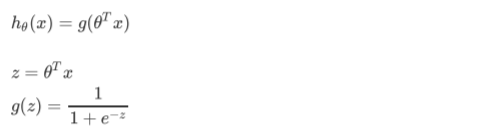
Logistic Function or Sigmoid Function
-
Decision Boundary
\(\theta^Tx \ge 0 \Rightarrow y=1\)
\(\theta^Tx \le 0 \Rightarrow y=0\)
- Cost Function

- Gradient Descent

-
\(h=g(X\theta)\)
\(J(\theta)=\frac{1}{m}(-y'log(h)-(1-y)'log(1-h))\)
-
\(\theta:=\theta-\frac{\alpha}{m}X^T(g(\theta X) -y)\)
-
Advanced Optimization
function [jVal, gradient] = costFunction(theta)
jVal = [...code to compute J(theta)...];
gradient = [...code to compute derivative of J(theta)...];
end

options = optimset('GradObj', 'on', 'MaxIter', 100);
initialTheta = zeros(2,1);
[optTheta, functionVal, exitFlag] = fminunc(@costFunction, initialTheta, options);
- Multiclass Classification: One-vs-all
Train a logistic regression classifier \(h_\theta(X)\) for each class to predict the probability that y = i . To make a prediction on a new x, pick the class that maximizes \(h_\theta(X)\)
- Overfitting
1) Reduce the number of features
2) Regularization


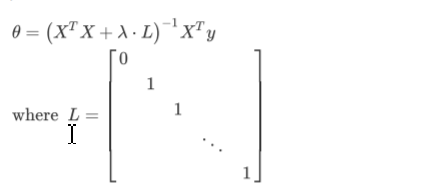
- Regularized Logistic Regression

Neural Networks
-
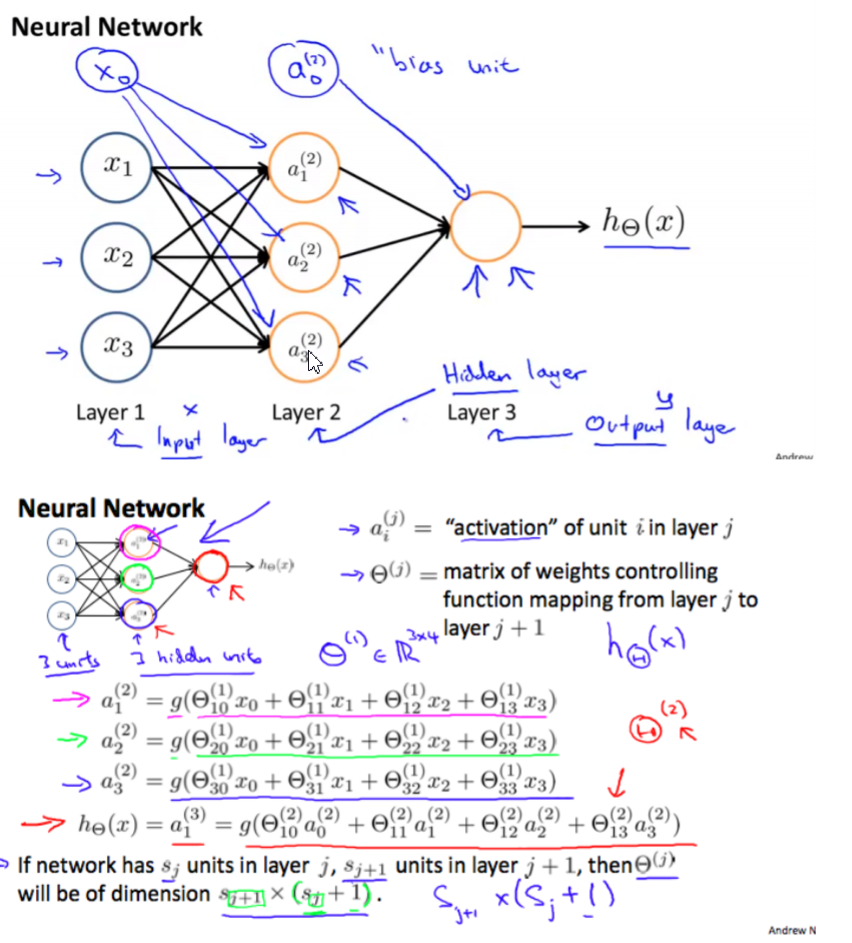
Model Representation
-
Forward propagation:Vectorized implementation
- Multiclass Classification
one-vs-all
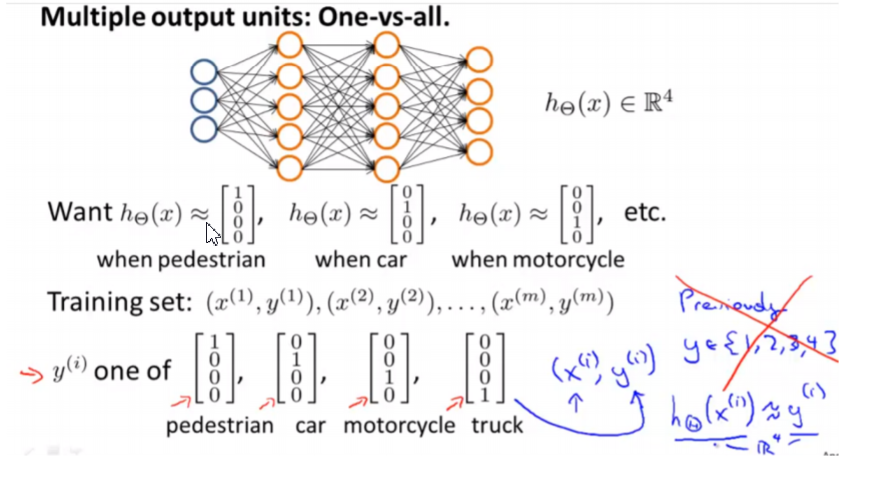
- Neural Network(Classification)
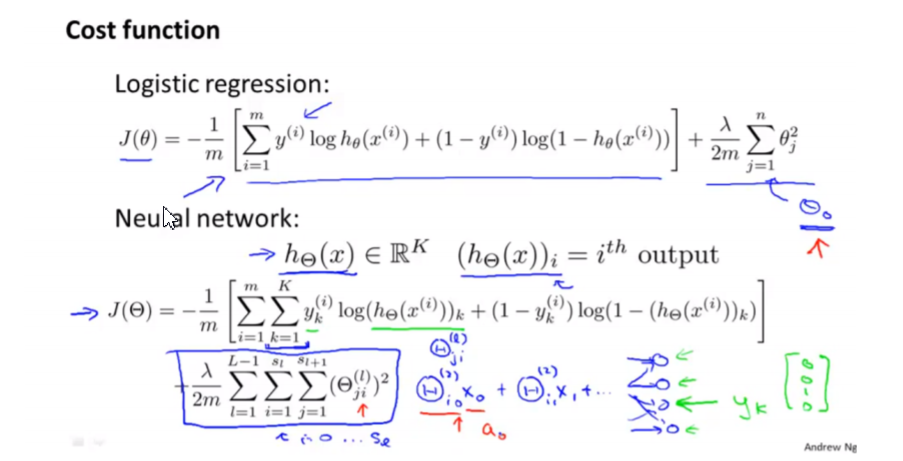
L = total number of layers in the network \(s_l\)= number of units (not counting bias unit) in layer l K = number of output units/classes
-
Cost Function
-
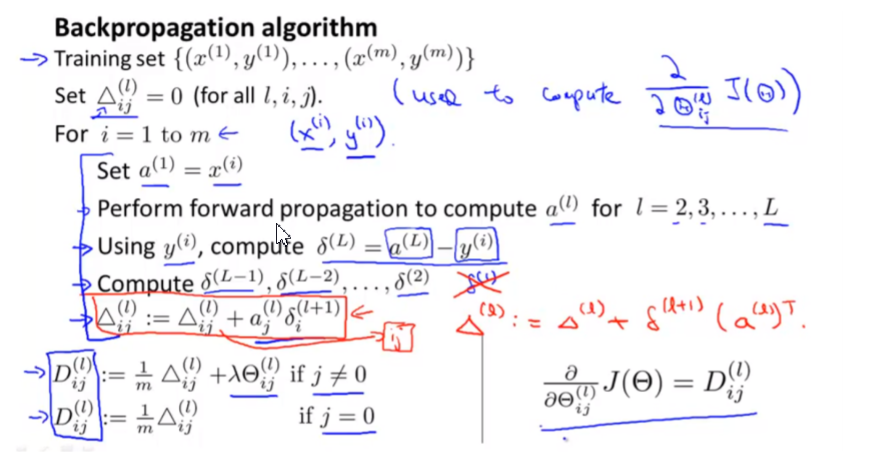
Backpropagation Algorithm
-
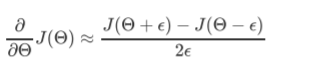
Gradient Checking
-
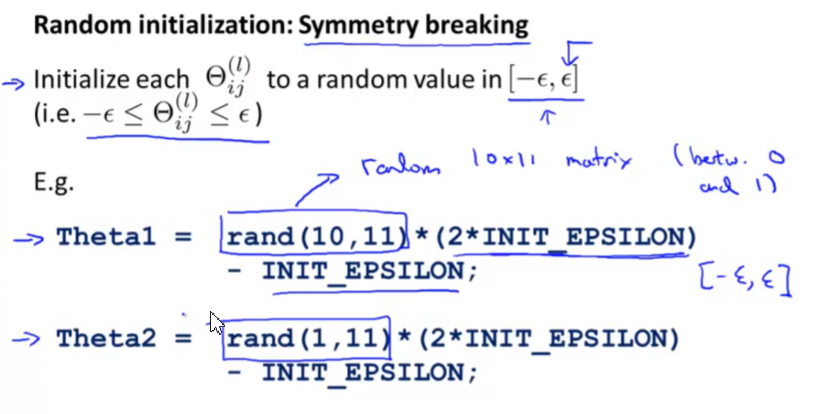
Random Initialization